
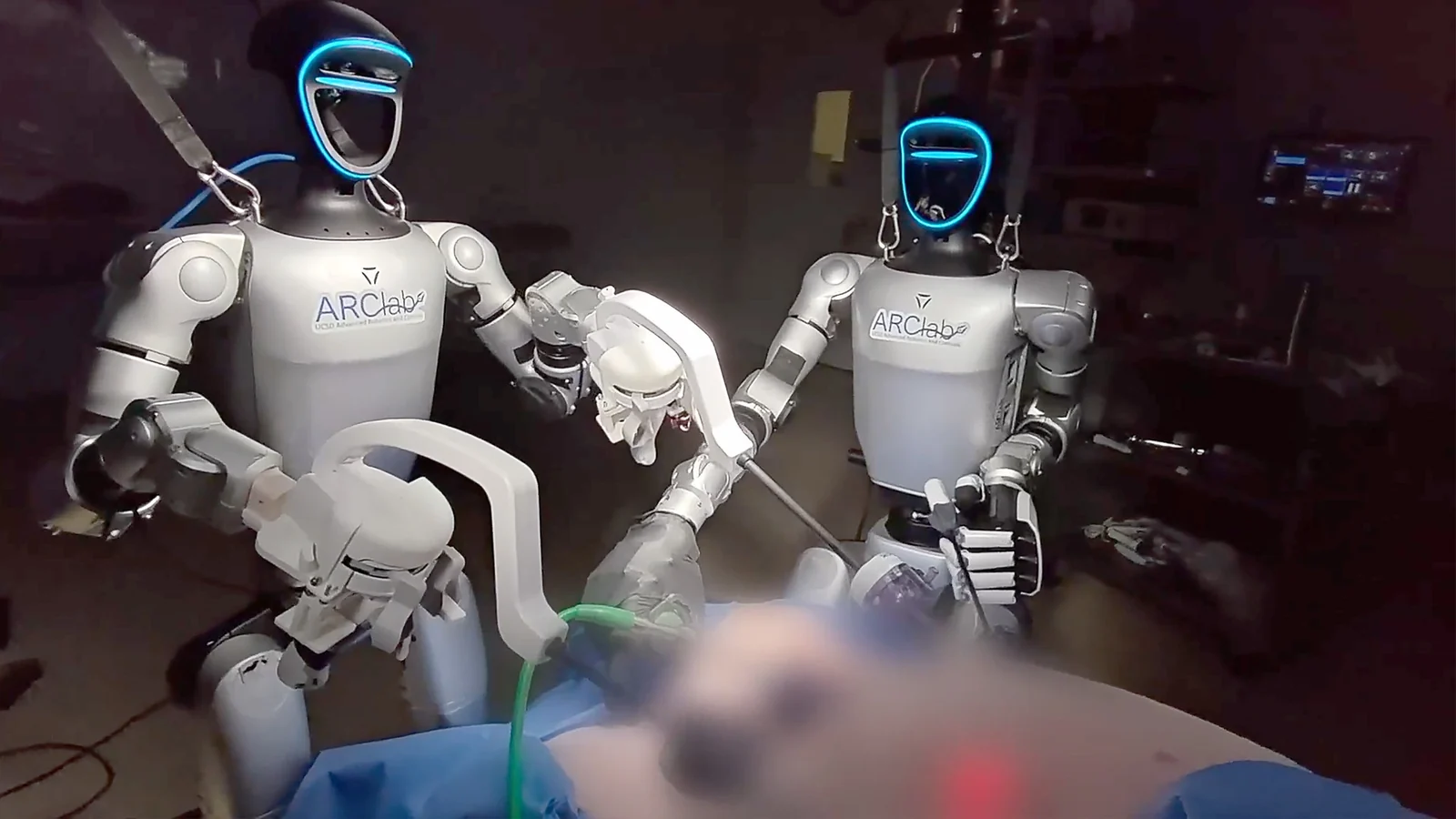
Humanoid robots have been used to complete live surgical procedures, but the robots were not operating independently.
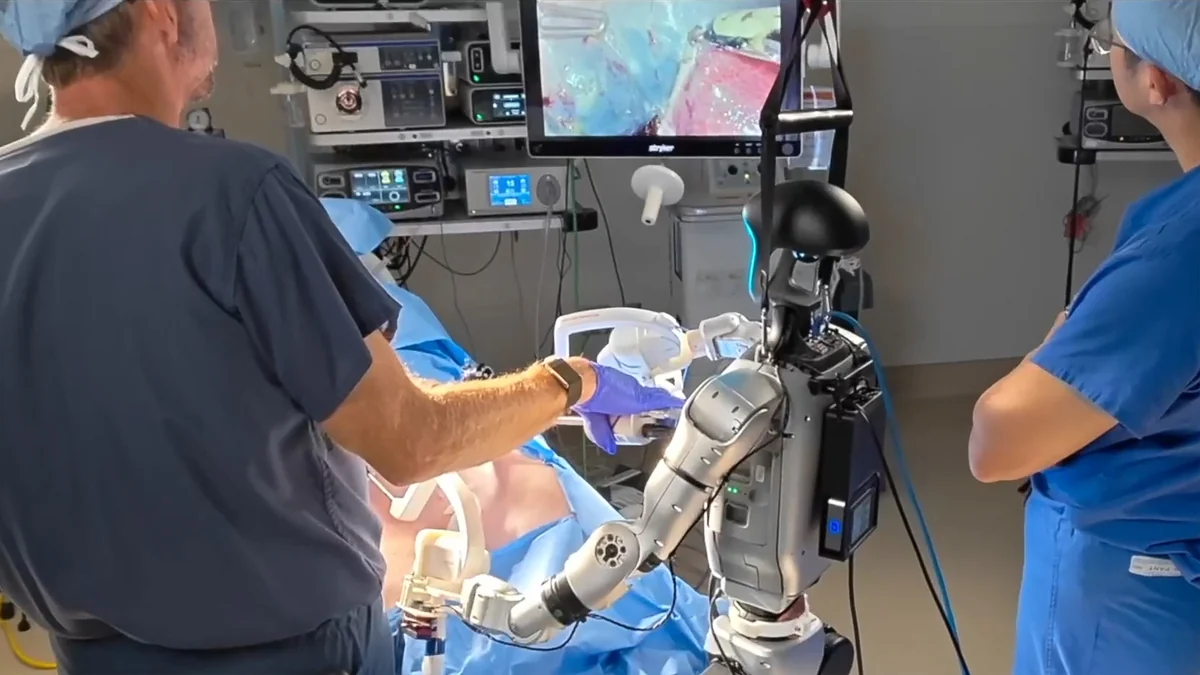
Researchers at the University of California San Diego used teleoperated humanoid robots during two laparoscopic gallbladder-removal procedures in pigs. One procedure paired a humanoid robot with a human surgical assistant. The second used two humanoid robots working side by side.
In both cases, surgeons remained in control.
The robots handled surgical instruments. Human surgeons controlled their movements and remained responsible for the procedures.
What happened
The study, published in Nature , evaluated a humanoid surgical platform through benchtop testing, simulated surgical tasks, and live procedures involving pigs.
The robots used standard laparoscopic instruments held through custom adapters. Surgeons operated the humanoids from a teleoperation console, translating their own control movements into movements by the robots.
The researchers describe the work as an in vivo feasibility study. It tested whether contemporary humanoid robots could function inside a surgical workflow that requires precise instrument control, coordinated movement, and interaction with an operating-room environment.
It did not test autonomous surgery, and no human patients were treated.
Teleoperated does not mean autonomous
The distinction between teleoperation and autonomy is central to understanding the result.
A teleoperated robot acts as a physical extension of a human operator. The surgeon decides what to do and controls the robot’s movements. An autonomous surgical system would need to perceive the situation, select actions, and perform at least part of the procedure without continuous human control.
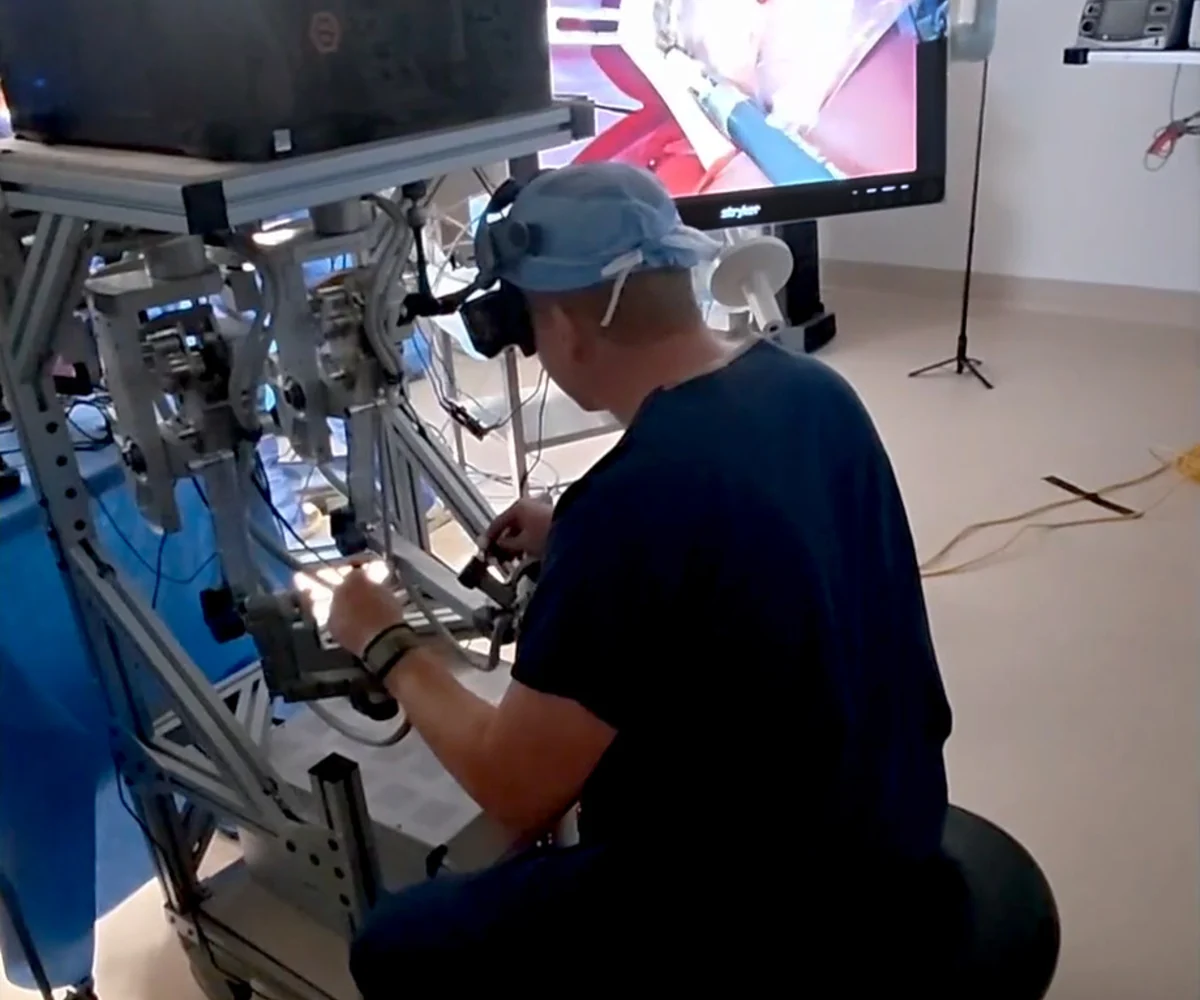
These humanoid robots did not independently diagnose the subject, plan the surgery, decide where to cut, or respond on their own to changing conditions.
The achievement was physical and technical: a general humanoid form could be adapted to manipulate laparoscopic instruments during a live preclinical procedure.
Why use a humanoid robot?
Most surgical robots are purpose-built systems with fixed arms, proprietary instruments, and operating rooms configured around them.
The humanoids used by the UC San Diego team were approximately five feet tall and weighed about 60 pounds. Their size and shape allowed them to stand beside an operating table and work within a space originally designed for people.
According to the university’s account of the study , the robots could be moved into an existing operating room and adapted to hold familiar surgical tools.
That flexibility is the underlying idea. A humanoid platform might eventually perform more than one tightly defined task without requiring an entirely separate physical system for each function.
Whether that approach will be safer, less expensive, or easier to deploy than established surgical robots has not yet been demonstrated in clinical care.
How medical robotics could help in the future
Medical robotics is broader than the idea of a machine replacing a surgeon.
Future systems could help hold or retrieve instruments, perform controlled physical tasks, support clinicians during procedures, or allow specialists to operate equipment from another location.
Humanoid robots may be particularly useful where equipment must move through spaces built for people and interact with tools already used by healthcare workers. Researchers also envision possible roles in remote communities, field medicine, and other settings where specialist teams or large surgical systems may not be readily available.
Those uses remain prospective. Remote surgery would require dependable communications, low latency, trained local support, strong safety systems, and clear responsibility when equipment or connections fail.
What remains unresolved
The procedures exposed several limitations.
The robots required repeated recalibration, and the operations took substantially longer than procedures performed with established surgical robotic systems. Communication delay between the control console and robot movement also remains an important issue, especially for any future long-distance use.
The researchers identify precision, stability, safety, latency, and clinical readiness as areas requiring further development.
The study also does not establish:
- that humanoid robots are ready to operate on people;
- that they can perform surgery autonomously;
- that they improve patient outcomes;
- that they are safer or more economical than existing systems;
- or that remote humanoid surgery can operate reliably across long distances.
Why this matters
The study is not evidence that an artificial surgeon is arriving.
It is evidence that a compact humanoid robot can be adapted to a demanding medical environment and controlled by surgeons during a live preclinical procedure.
That distinction makes the development more useful, not less interesting.
Medical robotics may advance first through systems that extend human reach, movement, and physical capacity while keeping clinical judgment and responsibility with trained professionals.
Editorial boundary
This was a preclinical feasibility study involving pigs. It did not evaluate surgery in human patients, autonomous surgical performance, routine clinical deployment, or patient outcomes.
This publication is informational. It is not medical advice, clinical guidance, procurement guidance, or a regulatory determination.
References
- Teleoperated humanoid robots for live surgery Nature.
- Surgeons Use Teleoperated Humanoid Robots to Perform Live Surgery, a World First University of California San Diego.
Show 1 more references Hide additional references
- World-first surgery using teleoperated humanoid robots Interesting Engineering.